01
Business AI & Agent Workflow Implementation
Start with real weekly work and connect knowledge, tools, rules, systems, and human decisions into an acceptable, operable capability.


Start with work that repeats every week: record the baseline, freeze one scenario, keep human decisions in place, then use real samples to verify efficiency, quality, cycle time, and cost.
Every engagement follows the same FFDE 5·6·7 implementation framework: qualify, validate, fortify, and hand off.
All three service areas use the FFDE 5·6·7 methodology, but address three distinct layers: business delivery, Enterprise Sovereign AI, and organizational capability.
Start with real weekly work and connect knowledge, tools, rules, systems, and human decisions into an acceptable, operable capability.
Decide what to rent, orchestrate, adapt, or retain — then validate, harden, and hand off cloud, hybrid, or private architecture.
Assess direction, data, technology, process, governance, and people readiness; build a roadmap and leave capability inside the team.
The three service areas answer what we do; the two engagement models answer how we work inside your organization.
Start with one real business workflow, deliver and validate the first capability, then hand it over so a team without a mature AI implementation function can run and improve it.
Best for: teams that know AI matters but lack use-case judgment, implementation capacity, or an operating owner.
Having a product does not mean it has entered the business. FFDE works alongside your product or AI team to embed the product in real workflows, validate actual use, and feed field evidence and improvement needs back into your roadmap.
Best for: organizations with product, digital, or AI teams that lack a mechanism to drive adoption, collect field feedback, and improve continuously.
Choose an engagement by readiness, or connect the formats as the evidence and operating capability deepen.
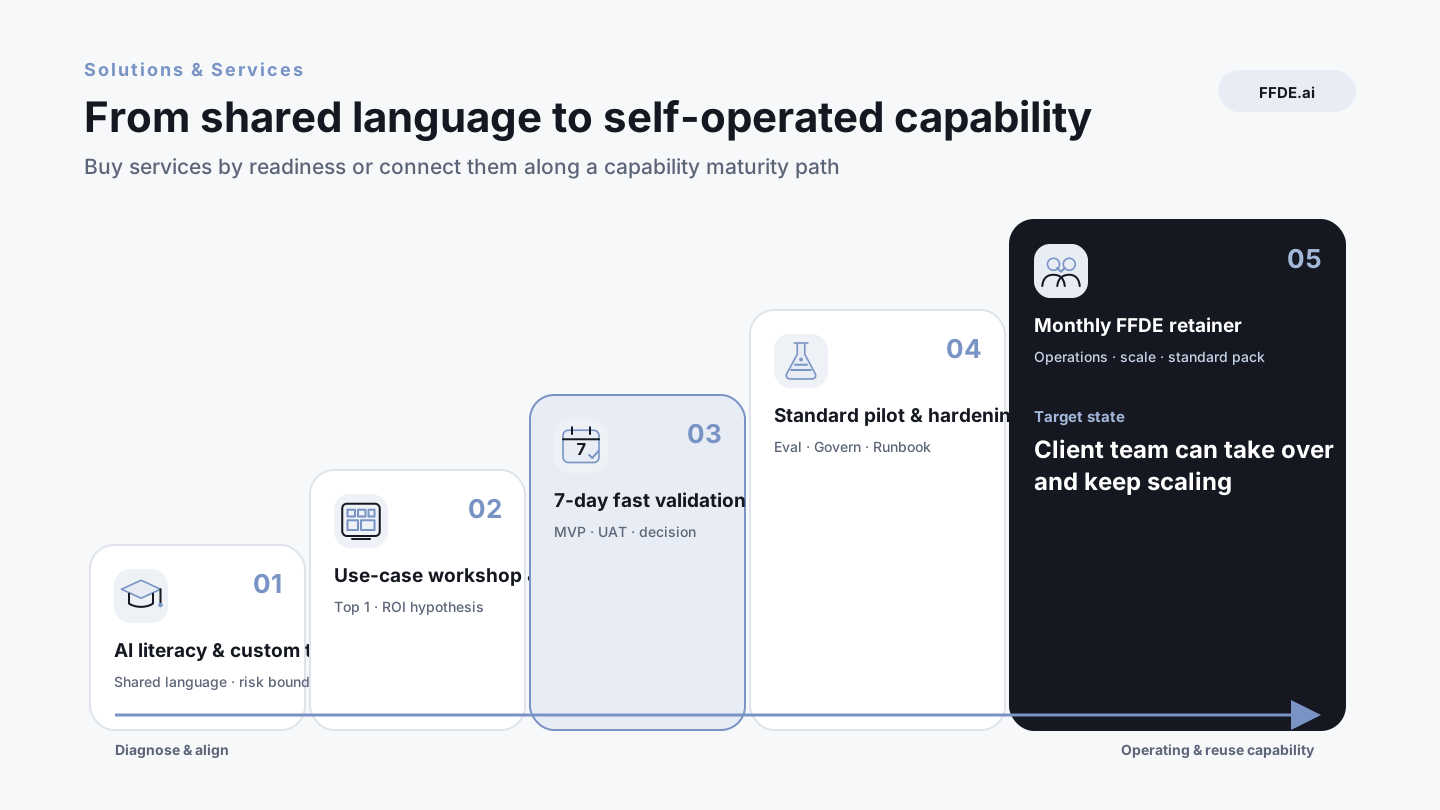
We first identify which condition is missing, then choose training, a workshop, a pilot, or ongoing co-piloting.
Too many ideas and no shared priority between leadership and business teams.
Response: AI alignment, leadership briefing, scenario workshop, and pilot blueprint.
Documents, spreadsheets, and records are scattered; answers are inaccurate or not traceable.
Response: data and knowledge governance, enterprise Q&A, and RAG evaluation.
The Agent is not connected to systems, approvals, or human–AI responsibilities.
Response: 7-day validation, business Agent embedding, and a standard pilot.
Permissions, evaluation, cost, exceptions, and knowledge updates have no operating owner.
Response: production hardening, Runbook, capability training, and monthly FFDE co-piloting.
Knowledge Q&A, customer service, sales assistance, document processing, content operations, and workflow automation are common starting points. The right choice depends on the owner, data, and acceptance bar.
Every use case states what AI does, which decisions people keep, and which metrics determine whether to continue.
Current waste: scattered sources, repeated searches, and the same answers rewritten.
AI workflow: permission-aware retrieval, sourced answers, human escalation, and failure feedback.
People decide: knowledge boundaries, exceptions, and final customer language.
Search time · first-find rate · citation rate · time to independence
Current waste: repeated ticket triage, policy lookup, drafting, and escalation decisions.
AI workflow: read the ticket, retrieve policy, draft guidance, validate risk, and retain evidence.
People decide: empathy, exceptions, refunds, and escalation.
First response · handling time · backlog · rework/escalation rate
Current waste: account research, opportunity summaries, follow-up email, CRM updates, and reports.
AI workflow: consolidate interactions and account data, then prepare briefs, next steps, and drafts.
People decide: customer judgment, communication strategy, commitments, and pricing.
Prep time · speed to follow-up · CRM completeness · opportunities per seller
Current waste: OCR, spreadsheets, forms, recurring reports, inboxes, and copy-paste between systems.
AI workflow: extract, validate structure, produce to template, and escalate only exceptions.
People decide: exceptions, approvals, financial judgment, and compliance.
Cycle time · manual touches · error rate · backlog/on-time rate
Current waste: research, drafting, formatting, and channel adaptation repeat for every asset.
AI workflow: evidence to draft, brand checks, format reuse, human review, and performance feedback.
People decide: point of view, brand, facts, compliance, and publication.
Time to publish · effort per asset · reuse rate · cadence/revision count
FFDE does not promise revenue from thin air. We turn the capabilities that precede growth into observable operating loops.
Reduce search, preparation, and waiting.
→ Fewer leads and customers lost to delayReduce omissions, rework, and conflicting answers.
→ Stronger conditions for retention and advocacyTest more content, messages, and workflow variants.
→ Find effective growth plays soonerGrow volume without matching headcount one for one.
→ Support scale and margin capacityCurrent time, steps, errors, backlog, and cost.
A frequent task with available data and reversible failure.
Real samples, UAT, human checkpoints, and known limits.
Expand, revise, or stop; every GO/NO-GO leaves evidence.
These delivery formats are shared across the service areas and mapped to your decision speed, readiness, and evidence requirements.
Best for: leadership lacks a shared direction, or the team does not know where to begin.
Process: align language, assess readiness, shortlist Top 3, and test pain, economics, and feasibility.
Deliverables: capability gap map, scenario matrix, decision checklist, pilot blueprint, and roadmap.
Next: 7-day validation, standard pilot, or an explicit decision to defer.
Best for: one Top 1 scenario is clear and you want directional evidence first.
Process: record the baseline on real samples, build the minimum main path, and keep knowledge, rules, and human review in place.
Deliverables: Agent MVP, UAT, before/after evidence, limitations, and GO/NO-GO.
Next: standard pilot, a larger sample, or a clean stop.
Best for: a clear scenario or demo lacks reliability, governance, or handoff evidence.
Process: strengthen knowledge, access, human review, evaluation, logs, cost, and exception handling.
Deliverables: formal UAT, acceptance report, Runbook, owner training, and known limits.
Next: production release, observation window, or co-piloting.
Best for: the first workflow is live and needs stable adoption, improvement, or expansion.
Process: review usage, quality, cost, failures, knowledge updates, and feedback monthly.
Deliverables: trend view, closed issues, update log, team capability, and a second-use-case decision.
Next: continue, transfer to self-operation, or replicate a standard pack.
Sovereign AI does not mean putting everything on-prem. We start with critical data and workflows, then decide what the business should rent, orchestrate, adapt, or retain.
Map data sensitivity, business risk, quality, latency, cost, and operating conditions into a staged Rent → Orchestrate → Adapt → Retain (ROAR) path.
Deliverables: decision memo, data/access boundaries, architecture options, TCO/ops estimate, and a 90-day roadmap.
Compare cloud, hybrid, and private options on quality, latency, cost, and operability around one critical workflow.
Deliverables: like-for-like Eval, data path, human-review boundary, rollback plan, and GO/NO-GO recommendation.
Connect the selected boundary to a model gateway, permissions, logs, knowledge, tools, evaluation, and rollback.
Deliverables: runnable workflow, Runbook, owner training, known limits, and an improvement rhythm.
Understand Sovereign AI vs private deployment → · See the methodology decision spectrum →
Training is not a final product demo. It gives each role the judgment, practice, handoff, and operating responsibility it needs—and leaves reusable work products behind.
Decide what to fund and what not to fund: opportunity ranking, data and security, accountability, and outcome metrics.
Help employees complete low-risk tasks and learn data boundaries, verification, and when not to trust AI.
Use real sales, service, finance, or operations work to break down tasks and leave reusable task cards and a scenario list.
Turn experience into rules, cases, evaluation items, and human boundaries for the knowledge base and Agents.
Build internal owners who can find workflows, maintain knowledge, collect errors, run business evaluation, and route issues.
Teach owners, technical, operations, and support teams to update knowledge, run Evals, release changes, handle incidents, and roll back.
See the six-layer enterprise AI training system → · Discuss a training program →
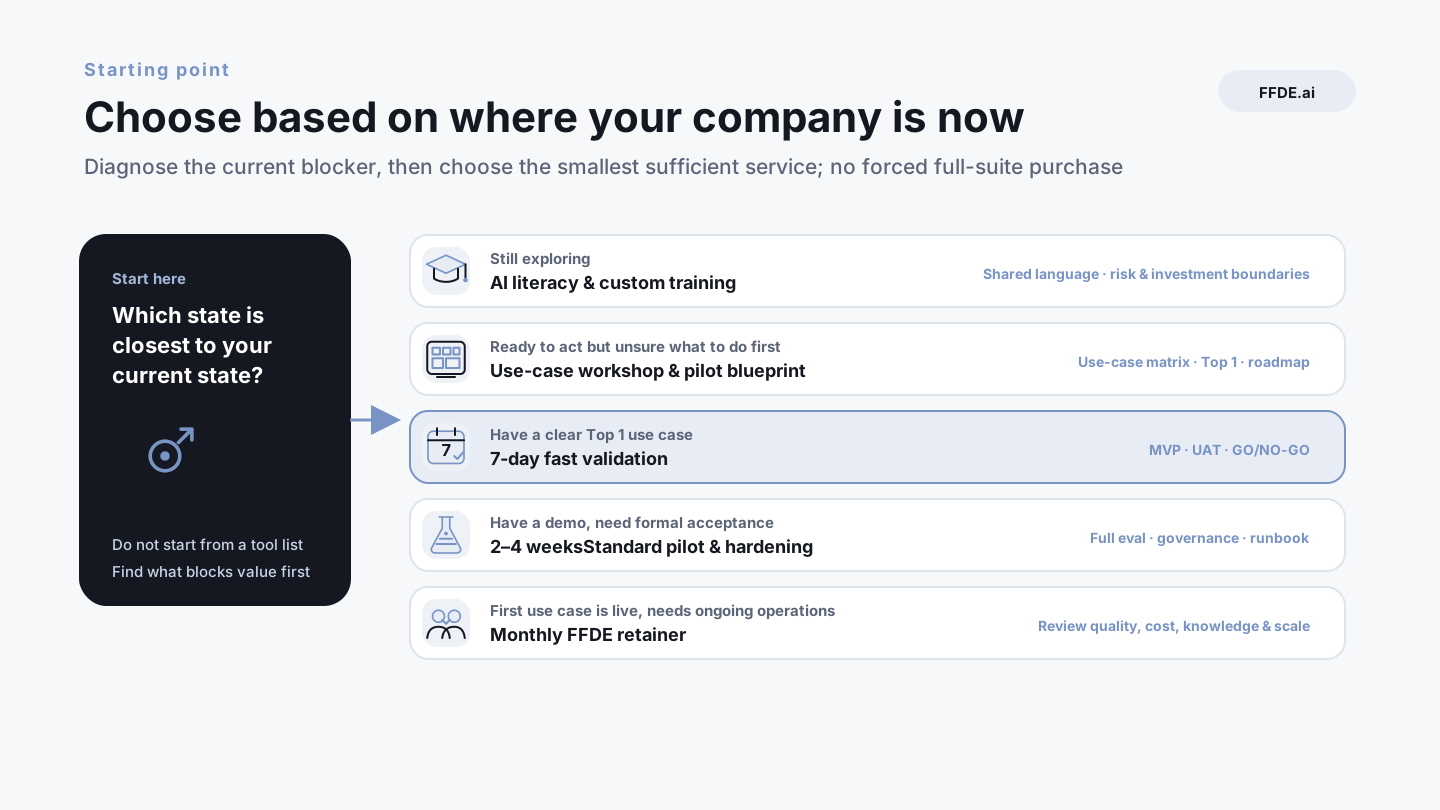
Start with transformation planning, capability assessment, or a leadership course to establish shared language, safety awareness, and investment boundaries.
Start with a scenario workshop and pilot blueprint to freeze the first high-ROI use case.
Choose 7-day fast validation, then decide whether to enter the standard pilot.
Choose standard pilot and production hardening, or move into monthly FFDE co-piloting.
Book a 30-minute consultation. We will assess your scene, data, and acceptance boundary before recommending a path.
Assess your real business workflow